

Bridging the Skill Gap: How Rajasthan’s ITIs Are Powering the State’s Manufacturing Boom
3/10/2026
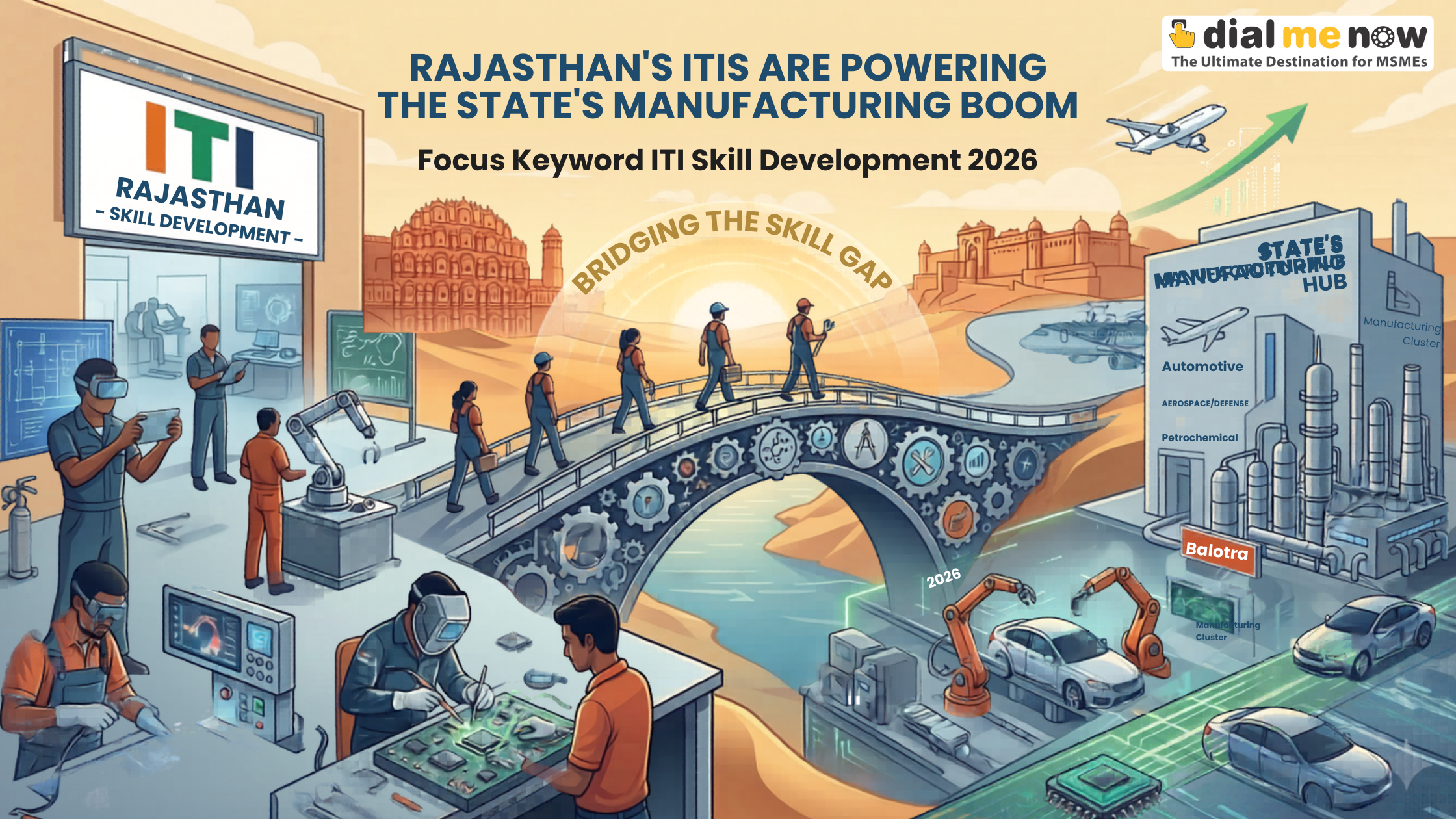
Rajasthan is no longer just a land of majestic forts and sand dunes. In 2026, it has emerged as a formidable manufacturing powerhouse. From the aerospace and defense units in Jaipur to the petrochemical clusters in Balotra and the automotive hubs in Bhiwadi, the “Pink State” is seeing a massive industrial surge. However, a factory is only as good as the hands that run it.
To fuel this ₹12.20 lakh crore infrastructure and industry push (as per the 2026 State Budget), Rajasthan has turned to its most vital resource: its network of Industrial Training Institutes (ITIs). By bridging the gap between traditional education and industrial requirements, ITIs are the silent engines behind the state’s manufacturing boom.
The Manufacturing Renaissance: Why Rajasthan is Booming in 2026
The year 2026 marks a turning point for Rajasthan’s economy. Several strategic moves have positioned the state as a top destination for global and domestic investors.
- The Aerospace & Defence Policy 2026: With a goal to become a major hub for defense manufacturing, the state has opened doors for large-scale projects ranging from ₹50 crore to over ₹1,000 crore.
- Jodhpur-Pali-Marwar Industrial Corridor: As a key node of the Delhi-Mumbai Industrial Corridor (DMIC), this region is attracting massive investments in electronics, electric vehicles (EVs), and renewables.
- Viksit Rajasthan @2047 Vision: A forward-looking roadmap that prioritizes industrial growth, innovation, and, most importantly, human capital development.
The ITI Network: Rajasthan’s Skill Backbone
Rajasthan boasts one of India’s largest skilling ecosystems. As of February 2026, the state has 1,537 ITIs (182 Government and 1,355 Private) that serve as the primary supply chain for industrial labor.
The Hub-and-Spoke Model
Under the PM-SETU (PM Skilling and Employability Transformation through Upgraded ITIs) scheme, Rajasthan has identified key clusters in Bhiwadi, Jaipur, Balotra, Kota, and Bikaner. These hubs are designed to align training with the specific industrial demands of the region.
- Bhiwadi ITIs: Focus on automotive and electronics.
- Balotra ITIs: Specialize in petrochemical and refinery-related trades.
- Kota ITIs: Aligned with the power and renewable energy sectors.
Dual System of Training (DST): Theoretical Meets Practical
The biggest criticism of vocational training has historically been the “Skill Gap”—students knowing the theory but failing at the machine. The Dual System of Training (DST) implemented in Rajasthan has fixed this.
- The Amalgamation: Students spend 6 to 12 months (for a 2-year course) directly on the factory floor of partner industries.
- Hands-on with 2026 Tech: Unlike old-school labs, DST allows students to work on the latest CNC machines, EV diagnostic tools, and AI-driven sorting systems.
- Industry Partners: Major companies in Rajasthan’s industrial areas are now co-designing curricula to ensure that an ITI graduate is “Job-Ready” from Day 1.
The 2026 Skill Stats: Rajasthan at a Glance
| Metric | Achievement (as of Feb 2026) |
| Total ITIs in Rajasthan | 1,537 |
| PMKVY 4.0 Certified Candidates | 2.50 Lakh+ |
| Apprenticeships (NAPS) | 1.04 Lakh+ Active Apprentices |
| Placement-Linked Outcomes | ~75% in Leading Industrial Clusters |
| Emerging Trades | EV Servicing, AI-ML, Solar Tech, Drone Piloting |
Preparing for Industry 4.0: AI and Green Tech
Rajasthan’s ITIs are no longer just about “Fitters and Welders.” The Rajasthan AI-ML Policy 2026 has integrated advanced technology into the vocational syllabus.
- The AI Literacy Program: A “Youth AI for All” initiative ensures that every ITI student understands the basics of AI-driven manufacturing and data annotation.
- Green Jobs: With Rajasthan leading India in solar energy, ITIs have introduced specialized trades for Solar PV Installation and Maintenance, creating a workforce for the massive solar parks in Bhadla and beyond.
- EV Revolution: As Jodhpur and Jaipur become EV hubs, ITIs are training a new generation of “Electric Vehicle Technicians” to handle battery management systems and charging infrastructure.
❓ Frequently Asked Questions (FAQ)
Q1: What is the PM-SETU scheme?
A: It is a ₹60,000 crore national scheme aimed at upgrading 1,000 ITIs to modern standards. Rajasthan is a key participant, focusing on hub-and-spoke models for regional industrial alignment.
Q2: Can I get a job abroad after completing ITI in Rajasthan?
A: Yes. With the new Skill India International Centres (SIIC) being established in Jaipur and Bharatpur, students are being trained specifically for global workforce mobility.
Q3: What are the highest-paying ITI trades in 2026?
A: Trades like EV Technician, Solar Power Specialist, Instrumentation Mechanic (Petrochemicals), and AI Data Annotator are currently commanding the highest starting salaries.
Q4: Is there a scholarship for ITI students in Rajasthan?
A: Yes, schemes like the Construction Worker Education Skill Development Scheme provide scholarships and rewards up to ₹1 lakh for students of registered workers.
Q5: What is the Dual System of Training (DST)?
A: It is a training model where the ITI and an Industry Partner share the responsibility of training the student, ensuring significant practical exposure.
Q6: Are girls encouraged to join ITIs?
A: Absolutely. Rajasthan is upgrading NSTI (Women) in Jaipur and providing specific boosters for female enrollment in technical trades.
Q7: How do I apply for an apprenticeship in Rajasthan?
A: You can register on the National Apprenticeship Promotion Scheme (NAPS) portal. Over 1 lakh youth in Rajasthan are already engaged as apprentices.
Q8: What is the starting salary for an ITI graduate in 2026?
A: Depending on the trade and location (like Bhiwadi or Jaipur), stipends start at ₹13,800/month, with full-time salaries ranging from ₹18,000 to ₹35,000/month.
Q9: Does Rajasthan have a dedicated policy for AI in skilling?
A: Yes, the Rajasthan AI-ML Policy 2026 specifically mandates AI education across all ITIs and polytechnics.
Q10: Which cities are the main industrial hubs for ITI placements?
A: Bhiwadi (Automotive/Electronics), Balotra (Petrochemicals), Jaipur (Aerospace/Gems), and Kota (Power/Renewables).
Q11: Can I start my own business after ITI?
A: Yes, the Viksit Rajasthan vision emphasizes entrepreneurship. Many trades like Electrician and AC Technician are perfect for starting a service-based business.
Q12: What is the “Skill Rajasthan” mission?
A: It is the state’s overarching initiative to synchronize all skilling efforts, ensuring that every youth has access to industry-aligned vocational training.
Q13: Do private ITIs have the same value as government ones?
A: As long as they are NCVT/SCVT affiliated, the certification is valid for both government and private sector jobs.
Q14: How has the 2026 Budget helped ITIs?
A: The ₹12.20 lakh crore allocation for industry and infrastructure has created a direct, massive demand for the skilled technicians that ITIs produce.
Q15: Where can I find a list of top ITI colleges in Rajasthan?
A: Portals like DialMeNow and Yuvamind provide updated 2026 rankings and placement records for both government and private ITIs.
Disclaimer
Placement and salary figures are based on 2026 market trends and can vary based on individual performance and company policy. Government schemes and scholarship amounts are subject to the latest official notifications from the Rajasthan Finance and Skill Departments.
Conclusion
The success of Rajasthan’s manufacturing sector is inextricably linked to the quality of its workforce. By evolving from basic workshops into high-tech innovation hubs, Rajasthan’s ITIs are ensuring that the state’s youth aren’t just spectators of the industrial boom—they are its architects. In 2026, the message is clear: the skill gap is closing, and Rajasthan is open for business.