

SEO vs AEO vs GEO: What Does Your Business Actually Need in the Age of AI Search?
8/26/2026
Quick Answer
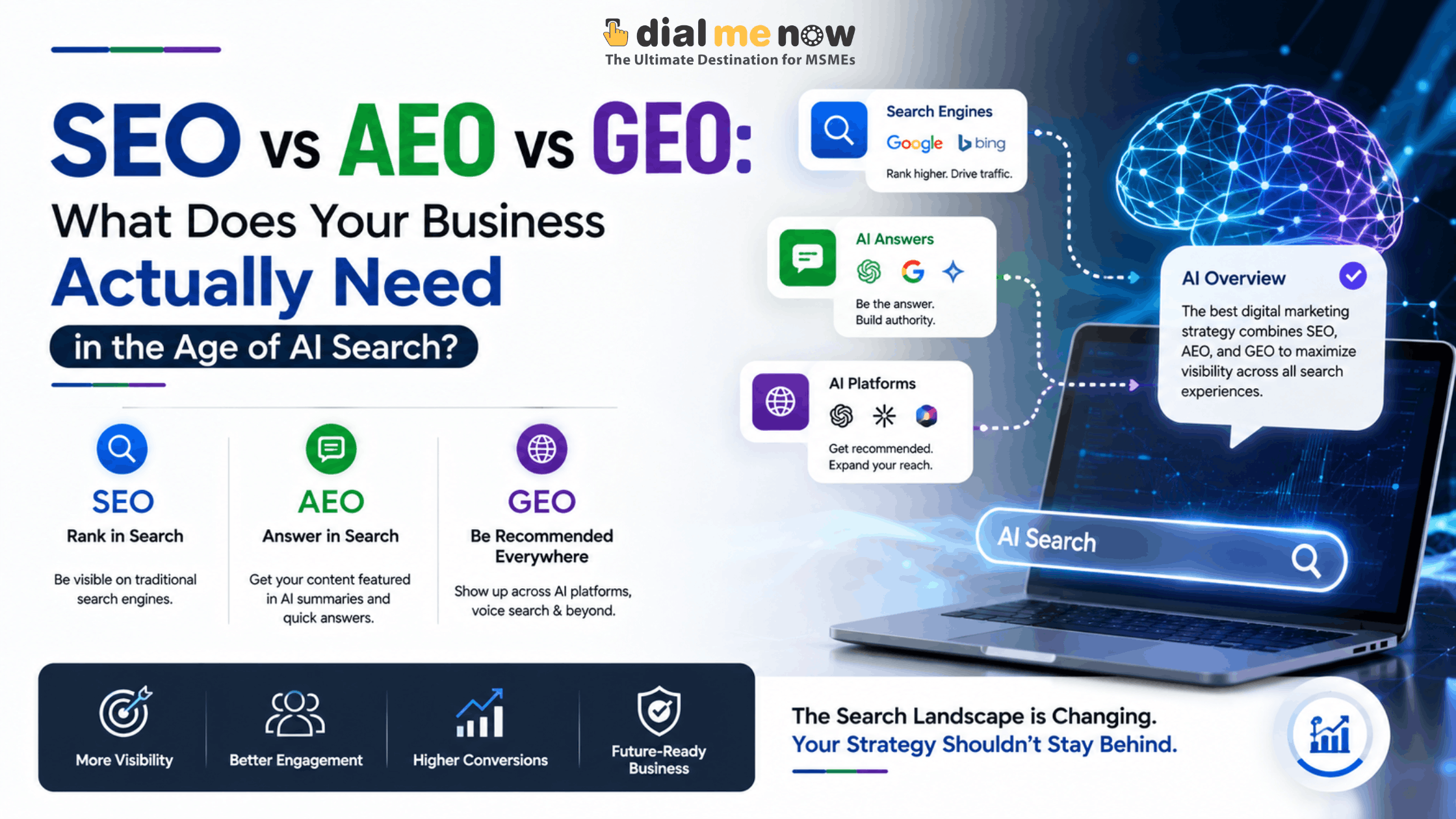
SEO helps search engines discover, understand and rank web content. AEO focuses on making information easy to answer directly, while GEO is commonly used for practices aimed at visibility in generative AI experiences. In practice, businesses do not need three disconnected strategies. They need one strong foundation: technically sound SEO, useful original content, clear answers, trustworthy brand information and structured topic coverage.
SEO was once the main acronym businesses needed to understand for search visibility. The rise of AI search has added two more: AEO, or Answer Engine Optimization, and GEO, commonly used for Generative Engine Optimization.
The terminology can make modern search sound more complicated than it needs to be. Agencies sometimes present each label as a completely separate service, even though the underlying work often overlaps.
Google’s 2026 guidance on generative AI search explicitly addresses common AEO and GEO misconceptions and continues to position core SEO best practices as foundational. For most businesses, the practical goal is therefore not to choose one acronym. It is to build content and websites that are understandable, useful and trustworthy across multiple discovery experiences.
What Is SEO?
Search Engine Optimization helps search engines discover, crawl, understand and surface web pages for relevant searches.
SEO includes technical accessibility, site structure, internal linking, content relevance, page titles, user experience, local optimisation and other practices. It also involves understanding the language and intent of potential customers.
Traditional SEO remains the foundation because AI search experiences still depend on access to high-quality web information.
What Is AEO?
Answer Engine Optimization is a useful way to describe content that is structured to answer questions clearly.
An AEO-friendly page may open with a direct definition, use question-based headings, organise comparisons in lists or tables and include concise FAQs where they genuinely help. The objective is not to manipulate an answer engine. It is to make the information unambiguous and easy to understand.
Good AEO usually improves the human reading experience as well.
What Is GEO?
Generative Engine Optimization is a newer industry term used for improving visibility or citation potential in generative AI systems and AI-powered search experiences.
There is no universal checklist that guarantees inclusion. Different AI systems use different retrieval, ranking and generation processes. That is why businesses should be cautious about anyone promising guaranteed placement in AI answers.
The most durable approach is to publish useful, original, well-structured information on technically accessible pages and build credible brand signals across the web.
Where SEO, AEO and GEO Overlap
- Clear understanding of user intent.
- Useful and accurate content.
- Descriptive titles and headings.
- Logical site architecture and internal links.
- Strong topic coverage rather than isolated keyword pages.
- Consistent business and entity information.
- Original expertise or first-hand knowledge.
- Readable formatting and concise explanations.
- Technical accessibility for crawlers.
- Ongoing content review and updates.
Where They Differ in Practice
SEO includes broad technical and website-level work that may not be visible inside the article itself, such as crawl management, indexation, redirects, canonicalisation, page performance and site architecture.
AEO is more visible in content structure. It encourages writers to frame and answer explicit questions clearly.
GEO expands the discussion to how generative systems select and synthesise sources. Because that ecosystem changes quickly, GEO should be treated as an evolving layer of search strategy rather than a fixed replacement for SEO.
A Simple Example for a Service Business
Imagine a company that offers custom website development.
An old-style SEO page might target ‘website development company’ repeatedly. A stronger modern content ecosystem would include a service page plus useful articles such as one-page versus multi-page websites, features of a business website, website redesign decisions, SEO-ready architecture and maintenance.
SEO makes those pages discoverable and connected. AEO makes each page answer its core question clearly. GEO-oriented thinking encourages original, well-supported information that can be understood and referenced in generative search.
The work overlaps far more than the acronyms suggest.
What Businesses Should Prioritise First
- Fix crawlability, indexation and major technical website issues.
- Create strong service and product pages that explain the offering clearly.
- Research real customer questions, not only high-volume keywords.
- Build topic clusters around those questions.
- Add concise answers followed by useful depth.
- Publish information that reflects genuine expertise and experience.
- Strengthen local and brand information where relevant.
- Use structured data accurately when a supported type applies.
- Monitor Search Console, enquiries and conversions.
- Refresh content as products, facts and search behaviour evolve.
What to Avoid in the AI Search Era
Avoid mass-producing hundreds of nearly identical articles, stuffing pages with definitions of every AI acronym or adding FAQ blocks that do not help readers.
Google’s guidance on generative AI content warns against scaled content that adds little value. Likewise, structured data is not a magic ranking switch and does not guarantee a rich result.
Businesses should invest in information quality, clarity and experience rather than chasing every new optimisation label.
How Dial Me Now Can Help
Dial Me Now offers digital marketing, online presence and web development services. A practical search strategy can bring technical SEO, content planning, local visibility and AI-era content structure together instead of treating SEO, AEO and GEO as unrelated campaigns.
To review your website and content approach, visit DialMeNow.in and submit an enquiry to the Dial Me Now team.
Frequently Asked Questions (FAQs)
1. What does AEO stand for?
AEO usually stands for Answer Engine Optimization, a term for structuring content so questions are answered clearly and directly.
2. What does GEO stand for in digital marketing?
GEO commonly means Generative Engine Optimization, referring to practices intended to improve visibility in generative AI experiences.
3. Is GEO officially defined by Google?
GEO is primarily an industry term. Google discusses the terminology but recommends established SEO practices and valuable content for its generative search features.
4. Do I need a separate GEO agency?
Not necessarily. First evaluate whether your existing SEO and content strategy already covers technical quality, original expertise, clear answers and brand visibility.
5. Can schema guarantee visibility in AI answers?
No. Structured data can help search systems understand content, but it does not guarantee rich results, rankings or AI citations.
6. Should we optimise for ChatGPT and Google in the same way?
There is overlap in creating clear, authoritative public content, but different systems use different retrieval and ranking methods. Avoid assuming one universal formula.
7. Are keywords still needed for AEO?
Yes, keyword and query research remains useful for understanding user language, but content should target intent and questions rather than keyword repetition.
8. Is an FAQ page enough for AEO?
No. Clear answers should exist throughout useful content. An FAQ section is only one possible format.
9. Does local SEO still matter with AI search?
Yes. Local businesses still benefit from accurate location, service, website and business-profile information.
10. Which should a small business start with: SEO, AEO or GEO?
Start with SEO fundamentals and strong content. Then improve answer structure and AI-era visibility as part of the same strategy.
Conclusion
SEO, AEO and GEO describe different aspects of a rapidly changing search environment, but businesses should resist turning them into isolated silos.
A technically strong website, clear service information, useful topic coverage, direct answers and original expertise support visibility across traditional and AI-assisted search. Terminology will continue to evolve; quality and clarity are more durable.
To build or modernise a search strategy around these principles, visit DialMeNow.in and send your requirements to the Dial Me Now team.
| Ready to discuss your requirement? Visit DialMeNow.in or use the Contact Us page to submit your enquiry. |
Suggested Internal Links for This Series
- SEO in 2026: What Changed After AI Overviews, AI Search and Generative AI?
- From Google Rankings to AI Answers: How Businesses Should Change Their SEO & Content Strategy
- What Makes a Good Business Website? 12 Features Every Modern Website Should Have
Editorial References
Reference guidance reviewed while preparing this article. These links are for editorial verification and may be retained or removed before publishing.
- Google Search Central – A New Resource for Optimizing for Generative AI in Google Search: https://developers.google.com/search/blog/2026/05/a-new-resource-for-optimizing
- Google Search Central – SEO Starter Guide: https://developers.google.com/search/docs/fundamentals/seo-starter-guide
- Google Search Central – Using Generative AI Content: https://developers.google.com/search/docs/fundamentals/using-gen-ai-content
Disclaimer
Search and AI systems evolve continuously. This article provides general educational information based on industry terminology and publicly available guidance reviewed in August 2026. No SEO, AEO or GEO activity can guarantee rankings, citations or traffic.