

The Future of Electric Vehicles (EV) in Rajasthan 2026: A Roadmap for Manufacturers and Startups
3/31/2026
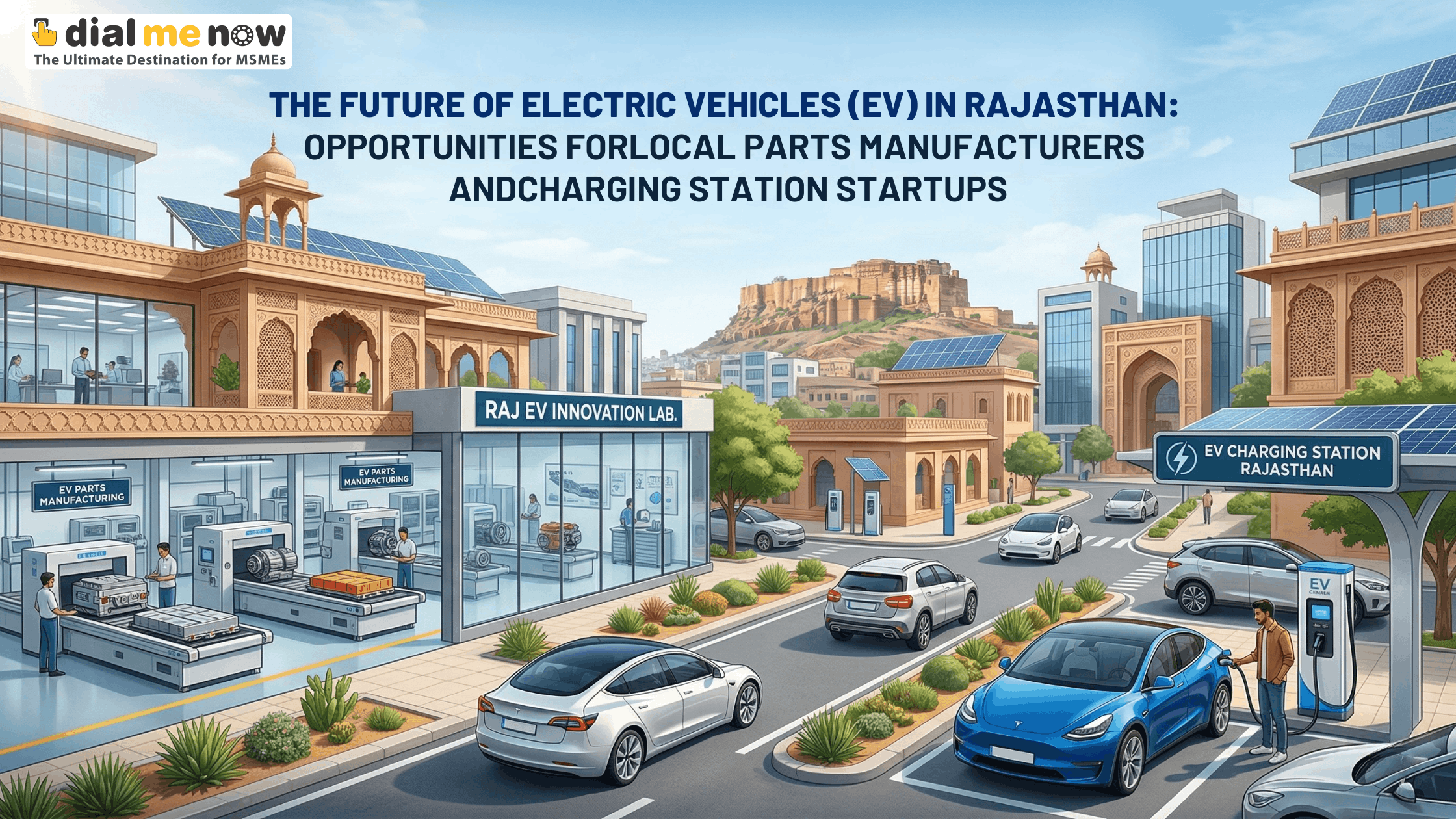
The landscape of Rajasthan is shifting. The vast, sun-drenched horizons that once defined the state’s heritage are now the fuel for its future. In 2026, Rajasthan has transcended its identity as a mere tourist haven to become one of India’s most strategic Electric Vehicle (EV) hubs.
With the Rajasthan Investment Promotion Scheme (RIPS) 2024 hitting its stride and the state’s “Green Growth” mission in full swing, the transition to electric mobility is no longer a distant goal—it is a live economic boom. For local MSMEs, parts manufacturers, and charging station startups, 2026 represents the “Golden Hour” of investment.
The Policy Windfall: Powering the 2026 EV Surge
The backbone of the EV revolution in Rajasthan is a robust policy framework that prioritizes localization. The state is not just encouraging people to buy EVs; it is incentivizing entrepreneurs to build them here.
- RIPS 2024 & Sunrise Sector Status: EVs and their components are classified as a “Sunrise Sector.” This grants manufacturers a 10% to 20% “Anchor Booster” on asset creation incentives.
- The 100% Exemption Advantage: New EV units in 2026 benefit from a 100% exemption on Stamp Duty, Land Conversion Charges, and Electricity Duty for the first seven years.
- PM E-DRIVE Integration: As the central PM E-DRIVE scheme reaches its terminal dates in 2026 for e-2Ws and e-3Ws, Rajasthan has stepped in with state-level subsidies to ensure the momentum doesn’t stall, specifically targeting commercial fleets and public transport.
Manufacturing Opportunities: The MSME Goldmine
Rajasthan’s industrial clusters in Bhiwadi, Neemrana, Tapukra, and Giloth have evolved from traditional auto-component centers into high-tech EV ecosystems. In 2026, the demand for localized parts is at an all-time high.
Key Manufacturing Segments for Startups:
- Powertrain Components: There is a massive gap in the local production of BLDC (Brushless DC) motors and PMSM (Permanent Magnet Synchronous Motors).
- Battery Pack Assembly: While cell manufacturing is capital-intensive, Battery Pack Assembly and the production of BMS (Battery Management Systems) are highly accessible for Rajasthan-based MSMEs.
- Thermal Management Systems: Given Rajasthan’s extreme temperatures (reaching 48°C), there is a niche market for specialized cooling systems and heat-resistant battery enclosures tailored for the desert climate.
- Wiring & High-Voltage Cabling: As EVs require more complex wiring harnesses than ICE vehicles, this remains a high-volume, steady-margin opportunity.
Charging Infrastructure: The New Startup Frontier
In 2026, the “Range Anxiety” of the past has been replaced by “Charging Convenience.” However, the ratio of EVs to charging points in Rajasthan still offers a massive window for startups.
Business Models for 2026:
- The Franchise (FOCO) Model: Property owners in Jaipur, Jodhpur, and Udaipur are partnering with Charge Point Operators (CPOs) to host stations, earning passive income while the CPO manages the tech.
- Solar-to-EV Hubs: Leveraging Rajasthan’s position as the solar capital of India, startups are building off-grid charging stations. These use solar canopies to charge batteries, reducing dependency on the grid and lowering operational costs.
- Fleet & Depot Charging: With the state’s push for e-buses and e-trucks in the Jodhpur-Pali-Marwar Industrial Corridor, specialized B2B charging hubs for logistics fleets are the most resilient revenue models.
The Math of Charging Power
Startups must understand the technical requirements of their hardware. The power $P$ required for a charging session can be calculated as:
$$P (kW) = V (Volts) \times I (Amperes) / 1000$$
For a DC Fast Charger typically deployed in 2026, providing 150kW to an EV with a 60kWh battery, the charging time $T$ is approximately:
$$T \approx \frac{\text{Battery Capacity (kWh)}}{\text{Charging Power (kW)} \times \text{Efficiency}} \approx \frac{60}{150 \times 0.9} \approx 26 \text{ minutes}$$
Comparison: ICE Manufacturing vs. EV Manufacturing (2026)
| Feature | Traditional ICE Parts | Modern EV Components |
| Complexity | High (2000+ moving parts) | Low (20-30 moving parts) |
| Material Focus | Steel / Cast Iron | Aluminum / Polymers / Copper |
| Entry Barrier | Very High (Capital intensive) | Moderate (Focus on Software/Electronics) |
| Govt. Support | Standard | Priority / Sunrise Sector Boosters |
| Skill Requirement | Mechanical Engineering | Mechatronics / AI / Chemical Eng. |
🛠️ 5. The Solar-EV Synergy: Rajasthan’s Unique Edge
Rajasthan is uniquely positioned to lead the V2G (Vehicle-to-Grid) movement. In 2026, the state’s “Integrated Clean Energy Policy” encourages EV owners to sell excess power from their car batteries back to the grid during peak evening hours.
Startups that develop smart-grid software to manage this bi-directional flow are seeing the highest venture capital interest in the Jaipur tech ecosystem. This synergy ensures that the “Green” in EV isn’t just a marketing term, but a grid-wide reality.
❓ Frequently Asked Questions (FAQ)
Q1: What is the most profitable EV component for a small startup in 2026?
A: Charging hardware (AC slow chargers) and Battery Management Systems (BMS) offer the best entry point due to lower capital requirements and high volume demand.
Q2: Does the Rajasthan government provide land for EV startups?
A: Yes, under the RIICO Direct Land Allotment Policy 2025, land is earmarked for EV and ancillary units in designated auto-hubs like Bhiwadi and Karoli.
Q3: How much investment is needed for a DC Fast Charging station?
A: In 2026, a medium-sized hub (4–8 chargers) requires an investment of ₹50 Lakh to ₹1.5 Crore, depending on the grid upgrade and transformer costs.
Q4: Is there a subsidy for local EV parts manufacturing?
A: Yes, the Rajasthan MSME Policy 2024 provides a Training Subsidy of ₹4,000 per worker/month and interest subsidies of up to 5-8% for EV-specific units.
Q5: Can I set up a charging station at my home/office in Jaipur?
A: Absolutely. The Rajasthan EV Policy 2022 (and 2026 updates) allows for “Deemed Permission” for setting up private charging points in residential and commercial complexes.
Q6: What is “Viksit Rajasthan @2047”?
A: It is the state’s vision document that targets a $350 billion economy, with green mobility and clean energy as its two primary pillars.
Q7: Which cities in Rajasthan have the highest EV registration?
A: Jaipur, Jodhpur, and Kota lead the charts, with a significant surge in e-2W adoption in Tier-2 cities like Sikar and Alwar.
Q8: Are there any tax benefits for buying an EV for my business fleet?
A: Yes, businesses can claim 40% depreciation in the first year for EVs, along with GST being capped at only 5%.
Q9: What is the “Thrust Sector Booster”?
A: It is an additional 10% incentive on top of the standard Asset Creation Incentive (ACI) provided to EV manufacturers under RIPS 2024.
Q10: Can I use solar power to run my charging station?
A: Yes, Rajasthan specifically incentivizes “Solar-to-EV” integration with additional capital subsidies for captive solar plants at charging hubs.
Q11: What is the average ROI for an EV charging station in 2026?
A: With current utilization rates, most well-located stations achieve a break-even point in 3.5 to 5 years.
Q12: Do I need a license to sell EV electricity in Rajasthan?
A: No. Following the 2026 amendments, charging EVs is considered a “Service,” not a “Sale of Electricity,” so you do not need a distribution license from DISCOMs.
Q13: What are the emerging “Secondary” EV hubs in Rajasthan?
A: While Bhiwadi is the primary hub, Neemrana and Kushkhera are emerging as specialized centers for EV R&D and battery testing.
Q14: Are there incentives for “Battery Swapping” stations?
A: Yes, Rajasthan is prioritizing swapping infrastructure in urban centers like Jaipur to support the massive e-rickshaw and delivery-fleet market.
Q15: How can DialMeNow help me find EV manufacturing partners?
A: We maintain a verified database of local auto-component manufacturers, tool rooms, and R&D labs, helping you form the right partnerships quickly.
Disclaimer
The EV market and government policies are subject to rapid change. Figures provided are based on the 2025-26 Economic Review and RIPS 2024 guidelines. We recommend a formal feasibility study before making significant capital investments. All “Sunrise Sector” benefits are subject to final approval by the state nodal agency.
Conclusion
The road to Viksit Rajasthan @2047 is paved with lithium and copper. For local manufacturers and startups, the window of opportunity is wide open. By aligning with the state’s aggressive green policies and leveraging our natural solar advantage, Rajasthan’s entrepreneurs aren’t just moving toward a cleaner future—they are building a more prosperous one.